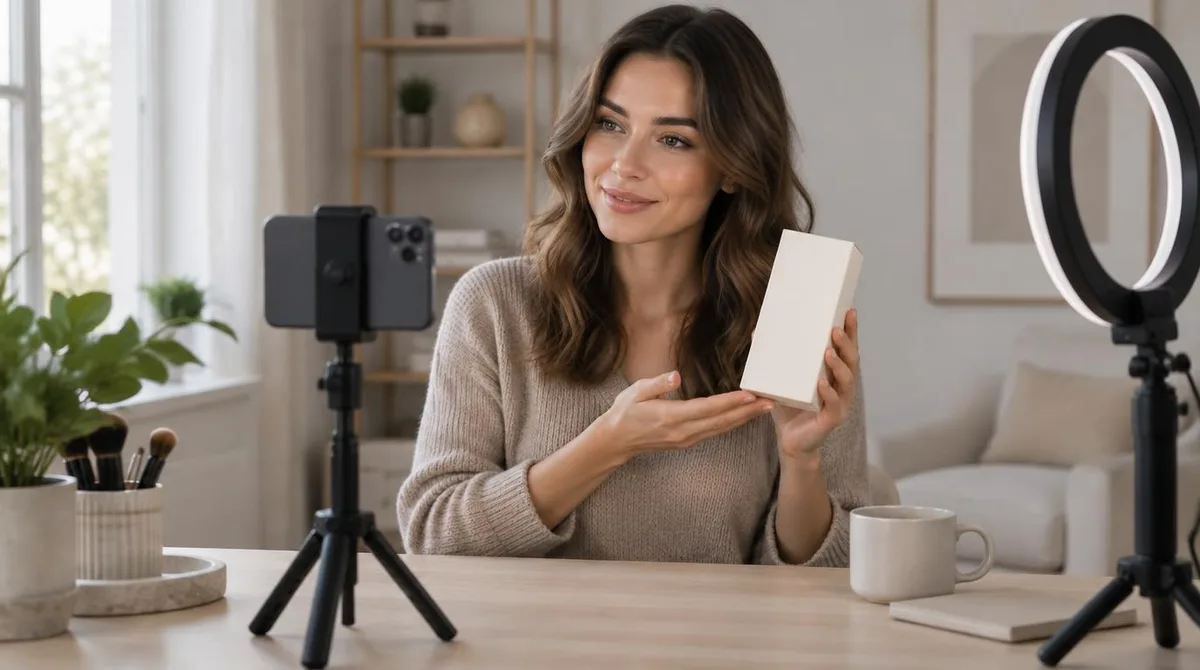
Influencer marketing examples that work on Instagram share one trait: a brand pays or inspires a creator to carry its message to a specific, trusting audience, rather than shouting at a crowd. According to Entrepreneur, the principle is simple — instead of selling directly to a large group, brands get the word out through people their followers already trust. The qualification that matters most: what works depends on matching the creator's audience to your customer, not on the size of the follower count.
The ten examples below are campaign formats, drawn from documented practice, that show how that matching plays out on Instagram. For each, we describe what the format is, who it suits, and what it is built to achieve. We do not promise results; as the sources note, outcomes vary with audience fit and content quality.
If you sell through Instagram, these formats sit inside the broader practice covered in our guide to social commerce explained: where buying actually happens, and they connect to the wider commerce coverage on this site.
What are the main types of influencer marketing examples?
The clearest way to sort influencer marketing examples is by creator size, because each tier changes the campaign's shape. According to Entrepreneur, mega-influencers are celebrities with followings in the millions, macro-influencers hold expertise in a field such as fitness or beauty, micro-influencers run engaged niche communities, and nano-influencers are everyday consumers speaking to a small, intimate circle.
That taxonomy is not trivia. It is the first decision in any campaign, and the next ten examples show how brands use each tier differently.
Example 1: the mega-influencer awareness push
A brand hires a celebrity-scale creator for a single sponsored post or Reel. The goal is reach, not conversion. According to Entrepreneur, collaborating with mega-influencers can produce a marked increase in brand awareness on a national or global scale. The trade-off is cost and low targeting precision, which is why this format suits launches and rebrands rather than niche products.
Example 2: the macro-influencer expertise endorsement
A macro-influencer is known for a specialty — say, technology or gaming — and reviews or demonstrates a product inside that specialty. Entrepreneur notes these creators have a more focused audience demographic, which can mean better targeting for brands chasing a specific market segment. The endorsement carries weight because the creator's authority is the product category itself.
Example 3: the micro-influencer niche partnership
Here a brand works with several small creators at once, each rooted in a tight niche. According to Entrepreneur, micro-influencer engagement rates are generally higher than those of mega and macro tiers, and these creators are perceived as more authentic and trustworthy. The format trades one big megaphone for many small, credible ones.
Example 4: the nano-influencer local campaign
Nano-influencers are everyday consumers with a passion for sharing their interests with a small community. Entrepreneur reports they can be particularly effective for hyper-local or highly specialized markets. A neighborhood business or a very narrow product finds its audience here, often at the lowest cost of any tier.
Example 5: the shoppable post
The creator's post carries product tags, so a follower can move from content to product detail without leaving Instagram. Entrepreneur lists shoppable posts among the features that make Instagram a multi-dimensional canvas for influencers. This is the format that most directly connects a creator's endorsement to a sale, and it depends on a seller's catalog being in order — a connection we cover in what Instagram's product tagging rules mean for your catalog.
Example 6: the Reels product demonstration
A short Reel shows the product in use rather than describing it. Entrepreneur counts Reels, alongside Stories and sponsored posts, among Instagram's influencer features. Demonstration works because it lets the audience judge the product with their own eyes, and tagged Reels can carry the same shopping path as a static post — see how to tag products in Instagram Reels.
Example 7: the Story sequence
Stories disappear after a day, which shapes the tactic: a creator walks followers through a product across several short frames, often ending with a link sticker. Entrepreneur names Stories among Instagram's core influencer formats. The format suits time-bound offers and behind-the-scenes framing, and it asks less production polish than a Reel.
Example 8: the product seeding program
Instead of paying a fee, the brand sends products to creators and lets genuine enthusiasm do the work. Entrepreneur's definition of the field includes inspiring influencers to get the word out, not only paying them. Seeding reaches the nano and micro tiers cheaply and produces content only if the product earns it. Our guide to how to run product seeding campaigns walks through the mechanics.
Example 9: the affiliate arrangement
The creator earns a commission on each sale traced to their link or tag. Entrepreneur lists conversions and sales among the key performance indicators of influencer campaigns, and affiliate structures make that measure automatic. For the creator side of that arithmetic, see how to start affiliate marketing on Instagram.
Example 10: the agency-run multi-creator campaign
A brand outsources the whole program — identification, contracting, tracking — to specialists. According to Entrepreneur, agencies such as Viral Nation, HelloSociety, and Digital Brand Architects connect brands with influencers, while platforms like Traackr, AspireIQ, and Grin provide identification, relationship management, and performance analytics. This is the format for brands that want influencer marketing as an ongoing channel rather than a one-off post.
What this means for your campaign
Our analysis of these ten formats is that the tier decision and the format decision are separable, and getting both right matters more than budget. A nano seeding program and a mega awareness push are both legitimate influencer marketing examples; they simply answer different questions. Entrepreneur's guidance is to look past follower counts and ask whether the creator's audience demographics, interests, and tone align with the brand's customers, and whether the creator handles sponsored content in a way that blends with their other work.
Measurement should match the format. Entrepreneur lists engagement rate, reach and impressions, click-through rate, conversions and sales, and follower growth as the common KPIs. An awareness campaign judged on sales will look like a failure it is not; a conversion campaign judged on reach will look cheap when it is not. If you are selling rather than merely promoting, our guide to how to measure social commerce ROI covers the accounting side.
One more caution, in the register this site keeps: none of these formats guarantees growth. The documented evidence supports that audience fit, content quality, and honest disclosure drive outcomes — and that terms, fees, and platform features change, so verify current rules before you commit budget.