Handling buyer questions in Instagram DMs means answering fast enough to keep interest alive, consistently enough to be trusted, and in a way that scales past your memory. The tools that make this possible are saved replies for common questions, published answers on your profile, and honest boundaries about when you respond. Buyers decide quickly — often within hours — and a reliable, human-sounding reply routine converts more conversations than any script.
This guide describes a workflow used by small sellers and creators; specific DM features vary by account type and region, so confirm current behavior per the help center as of August 2026. Nothing here requires third-party automation, and much of it is habit rather than tooling.
Why does response time matter so much?
A DM about sizing, shipping, or stock is a purchase intent with a timer on it. The buyer found you in a Reel, formed a question, and opened a chat; interest peaks at that moment and decays with every hour of silence. You are not just answering a question — you are the deciding factor in whether a warm lead cools. Speed matters more than polish, and consistency matters more than speed.
What different response patterns signal:
- Under an hour during work hours: a shop that is awake and attentive.
- Same day, reliably: a solo seller with boundaries — perfectly acceptable.
- Random gaps of days: a risk the buyer must weigh, and many decline.
Note that the platform itself surfaces responsiveness where business tools are in use, so your habits can become visible, not just felt. Set a standard you can keep every week, and then keep it.
How do saved replies work?
Saved replies are short templates you store in the business tools and paste with a couple of taps when a common question arrives. Per the help center as of August 2026, the feature lives in business and creator account settings, and availability varies by account type. The point is not to sound automated — it is to stop re-typing the shipping policy from memory at midnight, slightly differently each time.
Setting up a lean kit takes half an hour:
- List the questions you actually received this month from your DM history.
- Pick the five to eight that repeat — shipping time, sizing, returns, stock, price.
- Write each answer in two to four sentences in your normal voice.
- Save each as a reply with an obvious shortcut label you will remember.
- Review and update the set whenever a policy changes.
The voice rule matters more than the template rule. A saved reply should read like you on a good day, not like a form letter wearing your name. Lead with the answer, add the one detail that prevents the follow-up question, and end with a genuine opening for anything else.
Which answers belong somewhere other than DMs?
Every question answered only in DMs must be answered again, forever. Questions answered publicly — in a Story highlight, a pinned post, a product description, or the caption itself — keep working while you sleep. The inbox is for the personal, the negotiated, and the edge cases; the profile is for the predictable.
A simple routing rule:
| Question type | Where it belongs |
|---|---|
| Shipping times and costs | Highlight or pinned post; saved reply points there |
| Sizing and fit | Product description and a sizing highlight |
| Returns and refunds | Policy highlight with the full terms linked |
| Stock and restocks | Story updates; DM for specific requests |
| Custom or bulk orders | DM, always — this is where you close |
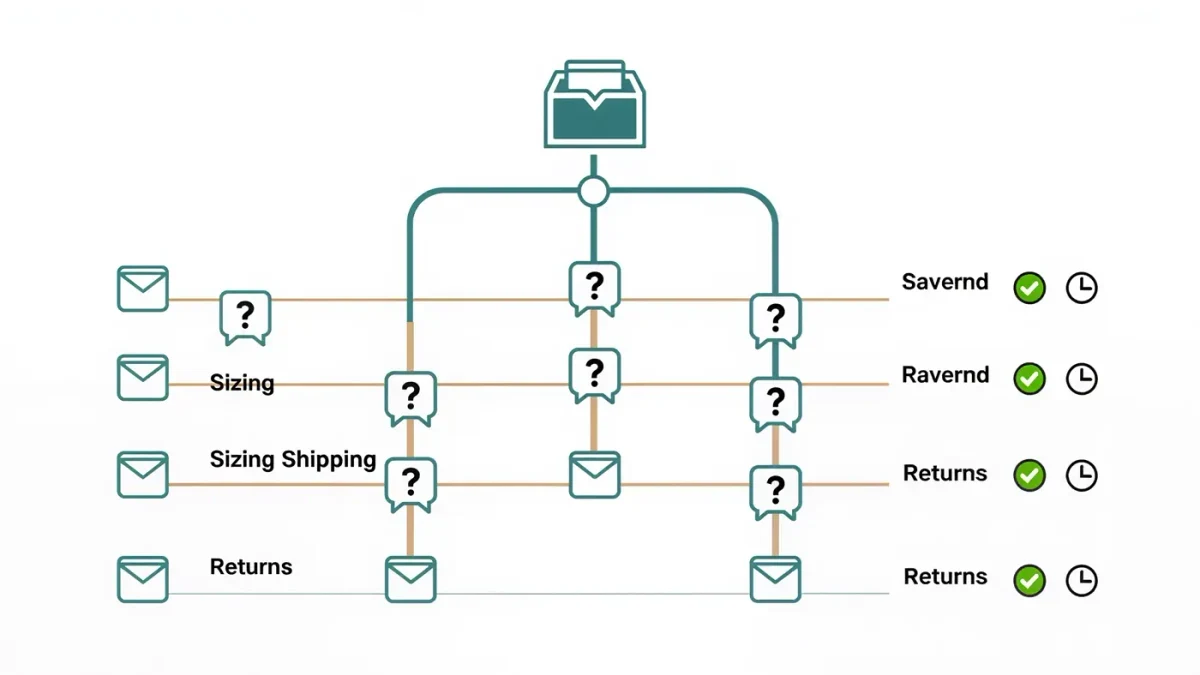
When a common question arrives anyway, answer it warmly, then add it to the saved-reply kit and, if it keeps recurring, to the public surface. That loop — DM to template to published answer — is how an inbox stops growing linearly with your sales.
How do you manage volume without burning out?
As sales grow, question volume grows with them, and unmanaged inboxes turn into the thing you avoid, which is the worst possible outcome for a commerce channel built on responsiveness. The defenses are batching, triage, and boundaries, applied without apology.
A sustainable daily pattern:
- Two or three fixed DM windows per day instead of continuous monitoring.
- Quick triage in the first pass: buyers first, everything else batched.
- Saved replies for the predictable; real typing for the personal.
- Labels or flags, where available, to mark conversations awaiting stock or payment.
- A published away expectation for days off, set via an away message where the tool exists.
Batching deserves a defense against the guilt it triggers. A buyer who receives a thoughtful reply at six in the evening is better served than one who receives a frazzled half-answer at noon. Response-time consistency over weeks is a better experience than response-time heroics you cannot sustain past launch week.
What should you never do in buyer DMs?
A few rules protect both conversion and your standing. Never process payments through informal channels a buyer did not expect — keep transactions on your shop or the platform's own checkout, and be wary of overpayment and off-platform payment requests, which are classic scam patterns that target sellers as often as buyers. Never argue with a customer in writing; take disputes to a calmer channel or sleep on it. And never let a saved reply answer a question it was not written for.
The short list:
- Keep payments on your real checkout; decline strange payment detours politely.
- Answer the question asked, even when a template is close but not right.
- Acknowledge problems fast, even before you have the solution.
- Keep receipts: screenshots of agreements on custom orders, timing, and price.
That last item resolves more disputes than any policy. When both sides can see what was agreed, in writing, conversations about disappointment stay short and usually end in understanding rather than chargebacks.
How do you turn questions into content?
Every buyer question is a piece of market research delivered free, and the best commerce content is made of answers. A cluster of sizing DMs becomes a sizing-guide Reel. Repeated stock questions become a restock-highlight habit. A genuinely confused question about how a product works is a script for the demo you should have made first.
A monthly ten-minute audit closes the loop:
- Skim the month's DMs and tally the questions by type.
- Mark any question asked three or more times.
- Publish one answer as content — a Reel, a Story, a caption.
- Retire or update the saved replies that underperformed.
Sellers who do this notice a quiet shift: over months, the questions get better. The predictable ones thin out because the content absorbed them, and what remains in the inbox is the valuable kind — custom orders, bulk interest, and the conversations that genuinely need a human.